
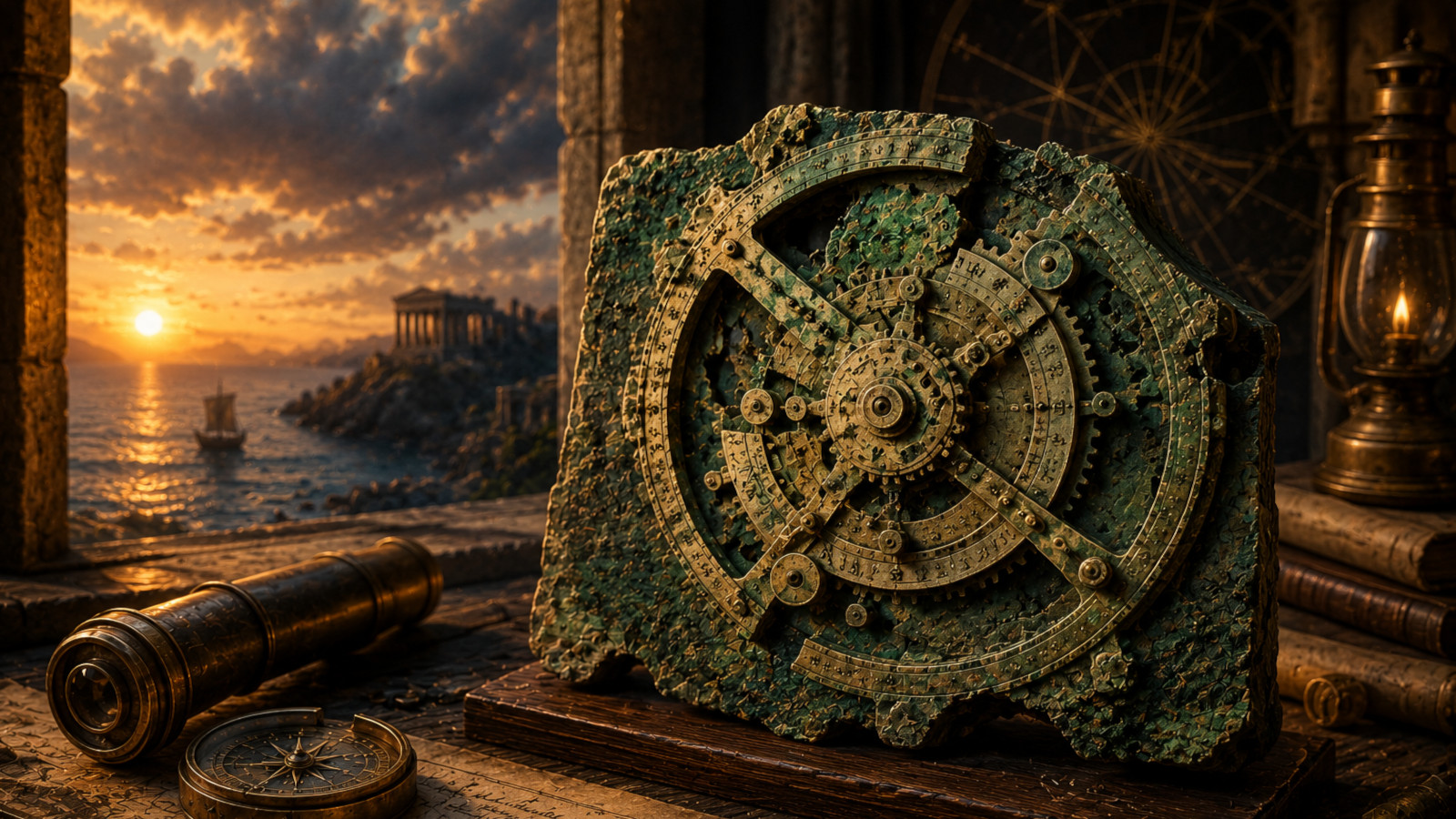
The open sea has always been a keeper of secrets. It takes ships, and sometimes, by accident, it preserves the things on board far better than dry land ever could. The single best example in all of history was hauled up off a tiny Greek island more than a century ago, and people are still studying it today. This is the story of the Antikythera mechanism, often called the world's first computer, and why a naval studio finds it impossible to look away from.
A shipwreck off a forgotten island
In the spring of 1900, a crew of Greek sponge divers sheltering from a storm dropped anchor near Antikythera, a small island between Crete and the Greek mainland. When they dove, they found a wreck on the seabed about 45 meters down: a Roman-era cargo ship that had gone down around the first century BC, loaded with bronze and marble statues, glassware, coins, and luxury goods. It was one of the richest ancient shipwrecks ever discovered, and over the following months the divers brought up treasure after treasure, at real risk to their lives at that depth.
Among the corroded bronze statues and broken pottery was a lump of green, calcified metal that nobody paid much attention to at first. It sat in a museum in Athens while the spectacular statues took the spotlight. Then it cracked open, and what was inside changed our understanding of the ancient world.
Gears that should not exist
Inside that unremarkable lump were gears. Finely cut bronze gears, dozens of them, meshed together in a way that nobody believed the ancient world was capable of. The level of precision engineering visible in the Antikythera mechanism would not be seen again in Europe for well over a thousand years, not until the geared astronomical clocks of the medieval period. Finding it in a wreck two thousand years old was, and still is, genuinely shocking.
For decades the device was a puzzle. Only with modern imaging, the X-ray and CT scanning that let researchers see through the corrosion and read the tiny inscriptions hidden inside, did the full picture come together. What they found was not a clock in the way we think of one. It was a calculator for the sky.
What it actually did
The Antikythera mechanism was a hand-cranked model of the cosmos as the ancient Greeks understood it. Turn the handle, and the gears would drive a set of dials showing the positions of the sun and the moon, the phase of the moon, and very likely the positions of the known planets. It tracked several different things at once:
- It predicted eclipses of the sun and moon, years in advance, with markings for whether they would be visible and at what time.
- It followed the irregular motion of the moon across the sky, accounting for the way it speeds up and slows down, using a clever pin-and-slot gear arrangement.
- It tracked the cycle of the ancient games, including the Olympics, marking which festival fell in which year.
- It modeled different calendar systems side by side, letting its owner line up the lunar and solar years.
In other words, a person standing on a dock two thousand years ago could turn a small bronze handle and read the heavens off a set of dials. That is why it gets called the first analog computer. It took inputs, ran them through a physical model of mathematical relationships, and gave back answers.
Why it was on a ship
Here is the part that ties it back to the water. This astonishing object was not found in a temple or a library. It was found at the bottom of the sea, on a ship. And that is no coincidence. Knowledge of the sky and skill on the sea have always been the same craft. Before satellites, before compasses even, sailors found their way by the sun, the moon, and the stars. A device that modeled the heavens was, in a very real sense, a navigator's dream made of bronze.
We will probably never know exactly who owned it or where it was headed when the ship went down. But it was crossing the sea, as so much ancient knowledge did, carried on a wooden hull through dangerous water. The ship was lost. The mechanism survived precisely because the sea swallowed it whole and sealed it away from the air that would have rusted it to nothing on land. The sea took the ship and, by taking it, kept the secret safe for two thousand years.
The sea as a keeper of mysteries
This is the thing that draws us to stories like this. The ocean is the largest unexplored space on the planet. It has swallowed fleets, cities, and entire chapters of history, and every so often it hands one back. The Antikythera mechanism is the most famous example, but the seabed is littered with wrecks that each carry a frozen moment of the world that built them.
That sense of the sea as something ancient, dangerous, and full of buried wonders is exactly the feeling we built SeaWar Sandbox V1 around. The open horizon, the storm, the thing under the water, the idea that the sea is older and stranger than the people sailing across it. The monsters you face in SeaWar, like Charybdis, come straight out of that same lineage of sea legend.
See it for yourself
What survives of the real Antikythera mechanism is on display at the National Archaeological Museum in Athens, alongside reconstructions that show how it would have worked. If you are ever in Greece, it is worth the trip to stand in front of a two-thousand-year-old computer that came up out of the sea.
And if the romance of the open ocean and its old, deep secrets is what pulls at you, that is the water we built our game on. SeaWar Sandbox V1 is free on the download page, on Windows and Android, and the SeaWar guide has the rest of the world we built on top of these old sea stories.