
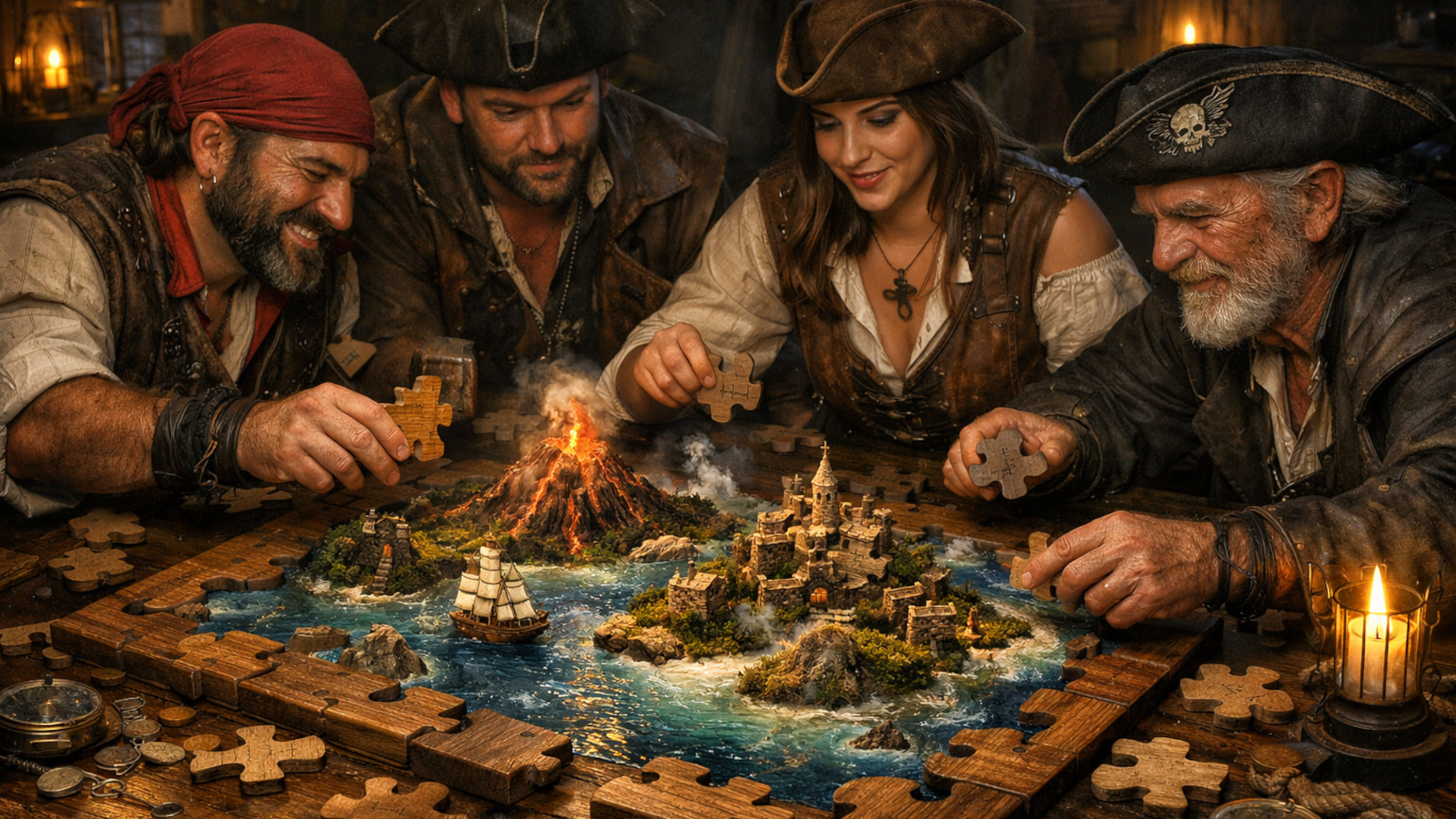
This is the first studio post. The why-we-exist post. The post we wanted to write before we wrote anything else. If you are arriving here from a launcher download, a search engine, a Discord ping, or a friend who sent you a link, this is the manifesto. It is the longest thing we will ever write about ourselves. Everything else flows from this.
The short version
The naval sandbox is one of the oldest, most reliable, most beloved genres in games. It has been quietly underserved on the single-player side for almost fifteen years. We are building SeaWar Sandbox V1 to fill that gap with a serious, modern, offline naval sandbox that respects the player’s time and the genre’s history.
That is it. The rest of this post is the long version.
The genre has never been more alive
Look at what is on the water in 2026. Sea of Thieves is in its seventh year and still has one of the most active communities in any live game. Skull and Bones has matured from a famously rough launch into a serious live-service naval game that hundreds of thousands of captains call home. World of Warships continues its decade-long run as one of the most reliable free-to-play games on PC. Naval Action still maintains a loyal core of hardcore captains. Sea Power showed that there is a real audience for cold-war naval simulation. Sailwind proved that a single developer can ship a peaceful, profound sailing experience and find an audience for it.
And below the top tier, the long tail is busier than ever. The browser pirate MMOs of the late 2000s, Seafight and Pirate Storm, are still part of the conversation in every naval community we have visited. Seafight is in fact still actively operated and is approaching its twentieth anniversary in the next handful of years. Pirate Storm is gone in its original form but the player demand is still there, which is why a growing scene of spiritual successor projects like Battle of Sea, The Atlas Online, Sea of Legend, Ocean’s Call, Armada Battle, and Terror of Sea have stepped in to carry the lineage forward. Mobile entries like Sea of Conquest and The Pirate: Caribbean Hunt have proven that the naval sandbox loop works on a phone. Indie projects in the spirit of Sid Meier’s Pirates, Pirates of the Burning Sea, and King of Seas are quietly cooking on Steam Next Fest every season.
The genre has never had more options for players. So why one more?
The gap
Here is the gap we kept noticing. Almost every great naval game in the last decade is either online and ongoing (Sea of Thieves, Skull and Bones, World of Warships, Naval Action, ATLAS, Seafight) or narrow in scope (Sailwind, King of Seas, Ultimate Admiral: Age of Sail). The classic open-world single-player naval sandbox with broad scope, full feature set, no subscription, no server queue, no daily login has been quietly missing for a generation.
The last truly mainstream entry in that exact lane was Sid Meier’s Pirates in 2004. There have been spiritual successors. Assassin’s Creed Black Flag in 2013 is the closest in spirit, but it is a pirate game inside an action-adventure game, not a dedicated naval sandbox. Several smaller titles have orbited the genre without owning it.
Twenty-plus years is a long time for a genre to wait.
What we are betting on
Four bets, in plain language.
1. The single-player audience is still here
The biggest single-player games of the last decade have all proved this. Baldur’s Gate 3 sold tens of millions of copies as a deliberately offline game. Elden Ring made offline souls-like the dominant subgenre of the era. The data is clear. There is an enormous audience for serious single-player experiences that respect the player’s time and do not require an active internet connection or a live-service subscription.
That audience deserves a naval sandbox built for them.
2. Player ownership matters
Save files on your disk. Game files you own. A launcher that does not phone home. A game that will run in ten years exactly the way it runs today.
We are not the only studio betting on this. The whole indie movement is built on it. But naval games specifically have been one of the most heavily live-service categories in the medium for a decade. Building one that is unambiguously yours matters.
3. Depth without homework
The middle ground between Sea of Thieves’s accessible arcade combat and Naval Action’s spreadsheet-friendly simulation has been undersupplied since Pirates of the Burning Sea wound down. We are aiming for that middle. Wind matters, distance matters, crew matters, but you can play the whole game without reading a wiki.
4. The horizon is still mythological
This is the soft one, but it is the most important. The reason the naval sandbox has lasted as a genre for a quarter-century is that the open sea is one of the deepest mythologies in human storytelling. The horizon, the storm, the unknown port. None of that has gone out of style. The medium has not finished mining it. We do not think we are anywhere near a saturation point.
The fact that browser MMOs from twenty years ago still have active communities is proof. The fact that fan-made Seafight-lineage projects are popping up year after year is proof. The fact that Sea of Thieves can run for seven years and still grow is proof. Players want to be on the water.
What we are not doing
We are not building a live service. We are not building a multiplayer game. We are not building a game with battle passes, microtransactions, or daily login bonuses. We are not racing the live-service category. We have no interest in that race.
We are also not building a hardcore simulator. The serious sim crowd is excellently served by Naval Action, Sea Power, and a handful of smaller titles. SeaWar is for the captain who wants depth without homework.
The promise
Free to download and play. One install. Saves on your disk. Six regions of a hand-crafted open sea. A combat model with weight and wind. A port economy that remembers. A reputation system that tracks the flag you fly. A single-player naval sandbox in the lineage of every great open-sea game we grew up on, built with modern tools for a modern audience.
Summer 2026. We will see you on the water.