
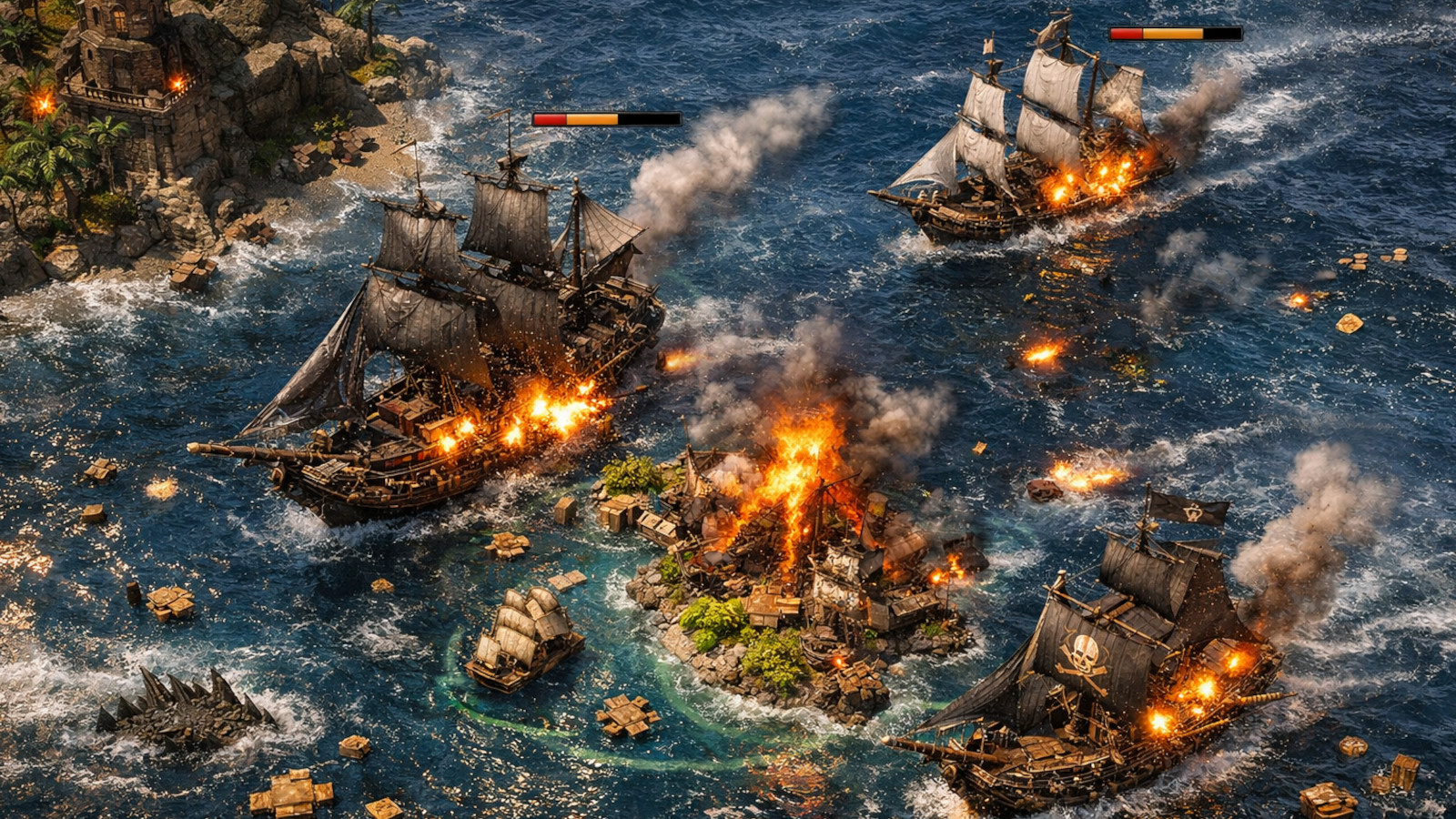
We have been building naval combat for SeaWar for a little over a year now. Long enough to have strong opinions, long enough to have changed most of them at least once. This essay is the long version of why our combat model looks the way it does, and which years of naval games we are stealing from.
The 2004 problem
If you played Sid Meier’s Pirates when it came out, you remember the feeling. Two ships on a flat blue plane, wind direction visible on the water, a brisk dance of broadsides where every shot you fired was a decision you could explain afterwards. The combat was simple in a way that hides how hard it is to design. Three weapons, four ship classes, one wind line. The whole experience.
That kind of clarity got slowly stripped out of the genre for the next fifteen years. By the late 2010s, naval combat had absorbed every UI convention from action-RPGs: ability cooldowns, hit-marker feedback, vendor-trash loot. Assassin’s Creed Black Flag brought it back into the conversation in 2013 with a more spectacle-driven version, and that template, cinematic naval combat as a feature of a larger game, was dominant for years. Skull and Bones spent a decade in the oven, then shipped in 2024 and started a long, patient rehabilitation of the genre on the live-service end.
None of those are bad games. We have hundreds of hours across them. But the question we kept asking each other in pre-production was, what did we stop noticing?
What the classics got right
Going back to the older naval games with fresh eyes, the same three things kept jumping out.
Wind as a decision
Sid Meier’s Pirates, Pirates of the Burning Sea, Naval Action, Ultimate Admiral: Age of Sail. All of them treat wind direction as the primary tactical variable. Where the wind comes from decides who can engage, who can disengage, and who is forced into a fight they did not want. Modern arcade-leaning naval games tend to abstract wind into a top-speed modifier and lose most of the texture.
We built SeaWar around the older approach. Wind is visible on the water. Wind decides engagement. Two captains, equal ships, fighting upwind versus downwind, will have wildly different fights.
Distance as drama
Older naval games respected distance. A chase took time. A pursuit was a real commitment of in-game hours. Sea of Thieves brought that back into a modern game beautifully. A chase across the open sea against a competent crew is one of the most exciting things the medium has produced this decade. World of Warships compresses it into ten-minute matches and still keeps the tension by tying it to detection range and torpedo lead times.
The lesson we took: a fight does not start when guns fire. It starts when sails are sighted on the horizon.
Crew as multiplier
The third lost variable, the one most modern arcade-leaning naval games drop entirely. Pirates of the Burning Sea had crew quality affect everything from sail handling to reload speed to boarding success. Naval Action still does. Browser MMOs like Seafight and Pirate Storm had simpler crew systems that worked because they were legible. The captain’s ship is not a machine, it is a crew with a hull around it. Modern games that forget this lose a layer that older players still miss.
What we are putting back
SeaWar Sandbox V1 ships with a combat model that has all three of those variables and treats them as first-class. Wind decides engagement. Distance has weight. Crew is the third multiplier. Beyond that, the philosophy is what matters.
- Every shot you fire should feel like a decision you can explain in the cockpit ten minutes later.
- Every fight should be readable from the deck without opening a menu.
- Every variable that matters should be visible.
That last point is the hardest. Modern UI design defaults to hiding complexity behind tooltips. We are doing the opposite. The wind line is on the water. The range bands are on the gun deck. The crew status is on the ratlines. You can play the whole combat layer without opening a single submenu.
The damage model
We get asked about this a lot, so here is the short version. Three layers, cascading. Shields, hull, armor. Shots eat shields first, hull second, armor third. Crit hits punch through tiers and apply status to the layer beneath. Crew quality reduces incoming damage and increases reload pace. Movement, both speed and turning radius, affects evasion against incoming fire. Wind affects movement. The whole chain is legible from the deck because every variable has a visible cue.
It is closer to Sid Meier’s Pirates than to Naval Action. It is deeper than Sea of Thieves but more readable than World of Warships. It owes a debt to every browser MMO whose UI we ever squinted at, including Seafight and Pirate Storm, which figured out how to surface ship state in a 2D browser tab fifteen years before AAA studios were doing it in 3D.
What we are not doing
We are not building a hardcore simulator. Naval Action and Sea Power exist, they are excellent, and we have no business competing with them on simulation depth. SeaWar lives in the same lane as a polished Sid Meier’s Pirates successor: legible, deep enough to reward expertise, simple enough to read in five seconds.
We are also not trying to replace the live-service titans. Sea of Thieves and Skull and Bones own crewed, multiplayer, ongoing naval combat. We are building the offline, single-player sandbox that lives in the gap they leave behind.
Why now
The genre is healthier than it has been in a decade. There is an audience for big live games, there is an audience for serious simulators, and there is a growing audience that wants a single-player sandbox without a subscription or a server queue. The browser pirate MMOs that gave a generation its first sea legs are still online and still updating. A whole new wave of Seafight-tradition spiritual successor projects have launched in the last two years. And the appetite for ship combat has never really gone away. It got served different products. It is time it had this one too.
That is the pitch, and the promise. The naval combat we miss is not gone. It is just waiting to be rebuilt with modern tools and a modern audience in mind. We will let you know when ours is ready to fire.