
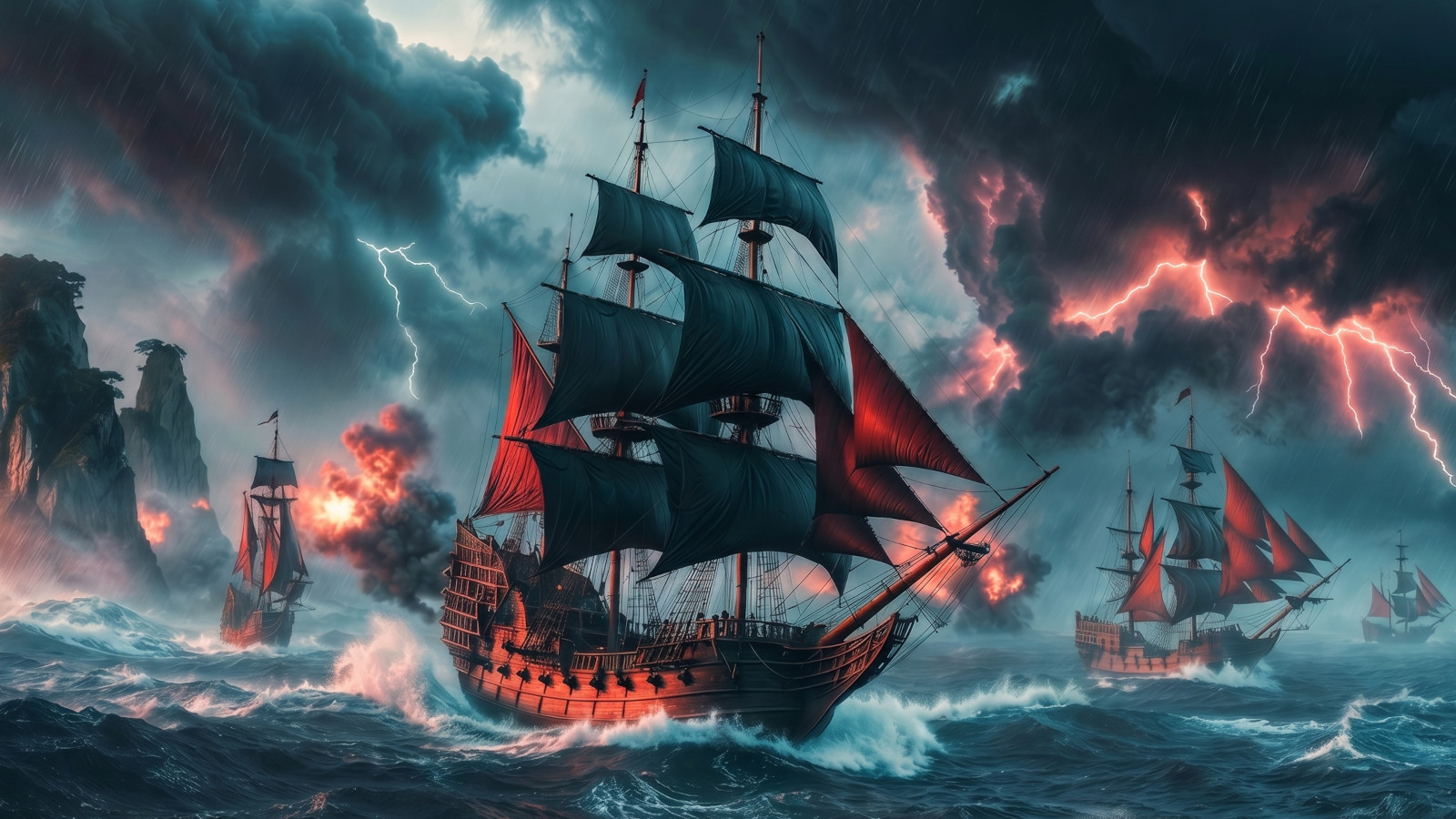
If you are not from Europe and the late 2000s, there is a chance you have never heard the name Pirate Storm. If you are, there is a very good chance you spent an evening on its servers at some point. Pirate Storm is the lost game in the naval MMO canon. It launched on a wave of hype, ran for the better part of a decade, and then quietly disappeared in a way that still bothers the people who loved it.
This is the studio history of Pirate Storm: how it started, how it ran, why it ended, and the modern wave of spiritual successor projects like The Atlas Online, Ocean’s Call, Sea of Legend, Battle of Sea, Armada Battle, and Terror of Sea that are keeping its design DNA alive.
If you have not yet, the Seafight history post is the companion piece. The two games share a publisher and a lot of DNA, but they are different stories.
The launch: 2011
Pirate Storm launched in 2011 from Bigpoint, the same German publisher that operated Seafight. From the start, Pirate Storm was positioned as the cinematic upgrade. Seafight was the 2D top-down classic. Pirate Storm was the visually richer, 3D-looking water layer, pirate-themed sibling. The audience was overlapping but distinct.
What it looked like at launch:
- Top-down combat with a 3D water effect. Still browser-based, still 2D in interaction, but with a 3D-rendered ocean that gave the visual identity a real lift over its predecessor.
- Pirate aesthetic. Where Seafight leaned into late-age-of-sail naval combat (frigates, ships of the line), Pirate Storm went full pirate. Crows’ nests, jolly rogers, kraken encounters, mythic atmosphere.
- Story-driven progression. A longer narrative arc than Seafight, with named NPCs, quest chains, and lore.
- Sea monsters as bosses. Krakens, sea dragons, leviathans, integrated into the world in a way that became one of Pirate Storm’s most-remembered features.
- Faction PvP and clan warfare. Inherited from Seafight, refined for the Pirate Storm meta.
- Free-to-play with cosmetic and convenience monetization. The Bigpoint standard model of the era.
It hit. Hard. In the first year of operation Pirate Storm picked up player numbers that justified its production budget, opened multiple regional servers, and started running event seasons.
Peak years: 2012 to 2015
The peak years of Pirate Storm overlapped with the broader peak years of browser MMOs as a category. Adobe Flash was still the default plug-in. Mobile gaming had not yet eaten the casual audience. Steam was still primarily known as a download client, not a social platform. There was a real, large, durable audience for serious browser games, and Pirate Storm caught most of the naval-pirate slice of it.
Big features that landed in this window:
- Ship customization. Hulls, sails, weapons, paint. A degree of cosmetic depth that anticipated what Sea of Thieves would do years later with a much bigger budget.
- Boss raids requiring coordinated fleets. Kraken hunts that needed five, ten, twenty players sailing together. This was the multiplayer pirate fantasy in browser form, and it is the spiritual ancestor of the Sea of Thieves world events.
- Loot economies. Drop tables, set bonuses, named legendary items. The Skull and Bones endgame loot loop is in this family tree.
- Cross-server events. Limited-time content that pulled players from across regions for shared participation.
- Cinematic event sequences. Cutscenes inside a browser game. Punching above the technical weight class of the era.
If you talk to anyone who played online pirate games in this window, the odds are excellent they have a Pirate Storm story. The kraken kill that took forty minutes. The clan war that ate a weekend. The cinematic moment in the Bermuda quest line. The aesthetic of Pirate Storm was the high-water mark for what a browser-based pirate game looked like.
The decline: 2015 to 2018
By 2015 the browser MMO category was under pressure. Mobile games had become the dominant casual platform. Steam had launched its competitive Free-to-Play push. World of Warships had launched in 2015 and immediately absorbed the entire naval-PvP audience for anyone with a PC. Sea of Thieves was in development at Rare, and its eventual launch in 2018 reset what a modern pirate MMO was supposed to feel like.
Pirate Storm did not die. But its audience contracted. Servers consolidated. Update cadence slowed. The events still ran but they were smaller.
Then came the Flash problem. Adobe announced the end-of-life of Flash in 2017. The actual sunset came in late 2020. Pirate Storm, like every other Flash-based MMO, had to make a decision. Port to a new tech stack, or shut down.
The sunset
Pirate Storm shut down. The official end-of-life happened in stages across 2017 to 2019 depending on the region and the server. The Flash dependency was technical context. The real reason was business. The audience had moved on, the cost of porting was high, and the projection for the modern audience did not justify the engineering.
For the players who stayed to the end, the shutdown was hard. There was no easy migration path. Saves did not transfer. Cosmetics did not carry forward. The game just turned off, server by server, until none were left.
The IP itself has not had a successor from Bigpoint. Seafight continues as the surviving naval brand in their catalog. Pirate Storm is dormant.
What it left behind
Pirate Storm left a design vocabulary that is still in use across the naval genre. It is one of the clearest examples in games of a title whose mechanical and aesthetic ideas outlived its servers.
- The cinematic pirate MMO template. Picked up by Sea of Thieves, Skull and Bones, and a long tail of pirate-themed projects.
- Boss raid as social event. The kraken hunts in Pirate Storm directly anticipated the world events in modern crewed pirate games.
- Mythic atmosphere as a design layer. Sea monsters, demonic enemies, supernatural weather. Standard in 2026 pirate games. Pioneering in 2012 browser games.
- Free-to-play monetization for naval combat. The Bigpoint model that proved a player could enjoy a serious naval MMO for free, and that the audience would still convert when the cosmetics were good.
The modern spiritual successors
This is where the story gets interesting in 2026. Pirate Storm has been gone for the better part of a decade, but the audience for what it offered never disappeared. Browser-based pirate combat. Top-down or near-top-down view. Mythic atmosphere. Fast sessions. Free-to-play. Real progression.
The current wave of spiritual successor projects is filling that gap. None of them call themselves a Pirate Storm clone. All of them clearly understand the lineage.
- The Atlas Online. Browser pirate MMO with a Pirate Storm-flavored atmosphere. Active development, growing community.
- Sea of Legend. Spiritual successor to both Pirate Storm and Seafight. Modern web tech, mythic-leaning art direction.
- Ocean’s Call. Indie browser pirate game with a more contemporary visual style. Real development team, regular updates.
- Battle of Sea. Closer to Seafight in pace but inheriting the cinematic ambition Pirate Storm formalized.
- Terror of Sea. Newer entry, dark atmosphere, monster-focused content in the Pirate Storm tradition.
- Armada Battle. Strategy-leaning sibling. Fleet management, browser-tab sessions.
None of these are Pirate Storm 2. All of them are the answer to a real question: where do the players go now?
Where Phalangix fits
We are not building a Pirate Storm successor. SeaWar Sandbox V1 is a single-player offline naval sandbox in the lineage of Sid Meier’s Pirates and Pirates of the Burning Sea, not a browser MMO. But the audience overlap is significant. If you spent your evenings on Pirate Storm in 2013, the combat philosophy in SeaWar is going to feel familiar. Wind matters. Crew matters. Sea monsters matter. The Demon Lord on Secret Isle in the northwest is going to remind you of a Pirate Storm kraken in spirit if not in form.
Pirate Storm taught a generation that browser games could be cinematic, that pirate MMOs could be serious, and that the mythic open sea is one of the deepest aesthetics in games. That lesson is in the DNA of SeaWar Sandbox V1. Honor where it is due.