
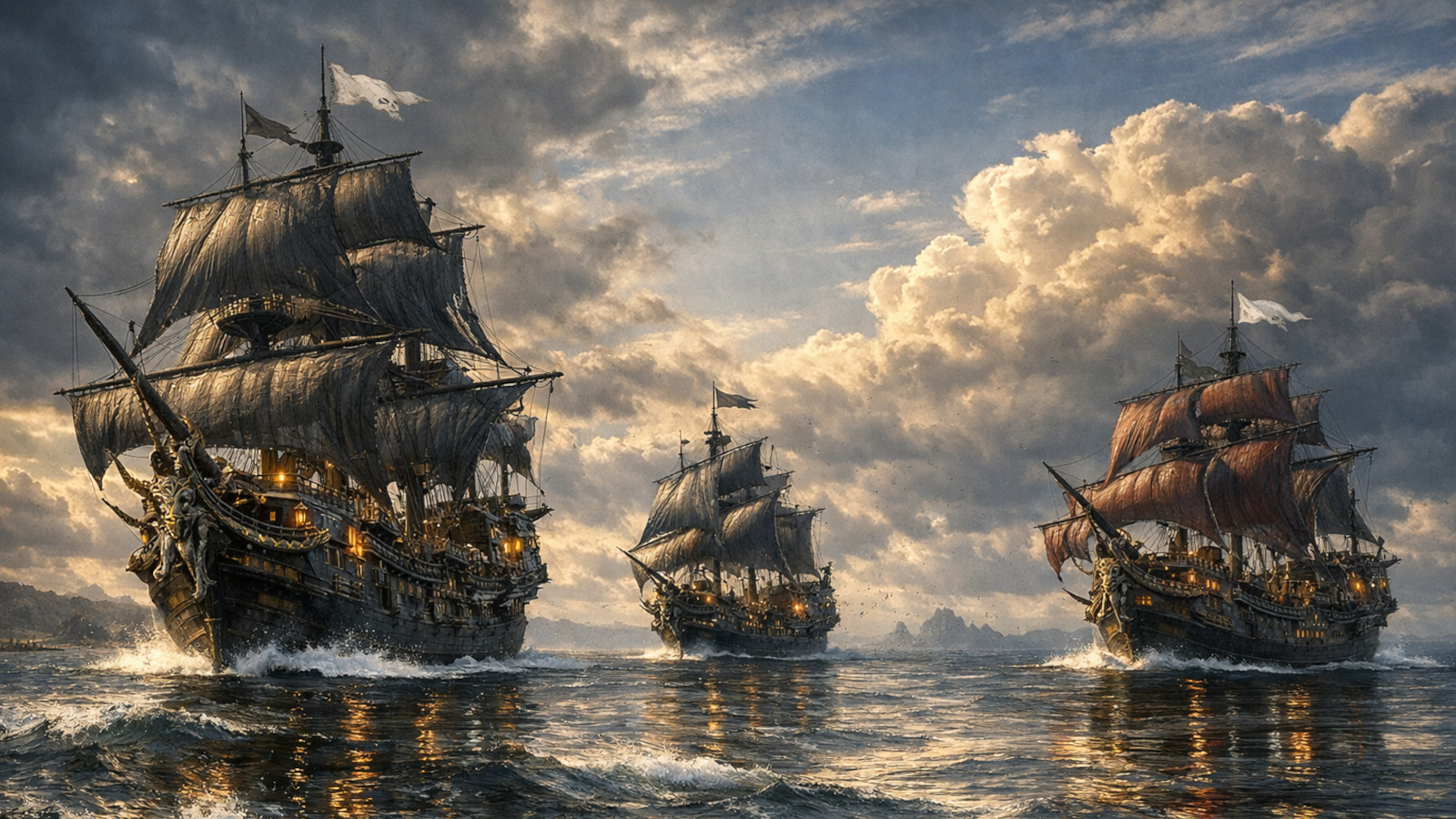
If you played online naval games in the late 2000s and you were anywhere near a European internet, the chances are very high that Seafight is in your memory somewhere. Maybe you stayed for years. Maybe you only logged on a few times. Maybe you remember clicking through the tutorial on a school PC and never going back. Whichever it was, Seafight is part of why the naval sandbox is a genre that still has an audience in 2026, and it deserves a serious post.
This is the studio history of Seafight: the launch, the golden era, the slow modern years, and the way its design fingerprints still show up across Sea of Thieves, Skull and Bones, Naval Action, World of Warships, and the modern wave of spiritual successor projects like Battle of Sea, The Atlas Online, and Sea of Legend.
The launch: 2006
Seafight launched in 2006, developed and operated by the German publisher Bigpoint. Browser-based, top-down 2D, Adobe Flash front-end, server-authoritative everything. You played in a browser tab. You did not install anything. You logged in, you picked a server, you sailed your tiny pixel ship out of a starting port and started shooting other tiny pixel ships.
The pitch was simple. Naval combat that fits in a browser. No client install. No store-bought disk. No subscription. Free to play, with a cosmetic and convenience-leaning monetization model that was novel at the time and is industry-standard now.
What it actually delivered was deeper than the pitch. By the late 2000s Seafight had real ship progression (frigates, ships of the line, dreadnoughts), real upgrade trees (sails, armor, weapons), real economy (gold and pearls), and a faction system that drove cross-server PvP. The combat itself was twin-stick. WASD to move, mouse to aim, real-time. Cannons had reload timers. Ammo types had different damage and range profiles. Crew skills modified the whole equation.
It was sharper than most browser games of its era because it took the genre seriously.
The golden era: 2008 to 2013
Five years that are still spoken about with affection by anyone who was online for them. Seafight peaked in this window in concurrent players, in active servers, in event participation, and in cultural footprint. The game ran on dozens of regional servers (Germany, France, Italy, Spain, Poland, Hungary, Turkey, Russia, Brazil, and more), each with its own community, its own meta, its own clans, its own dramas.
The big features that landed in this era:
- Maps with structured progression. Starter maps for newcomers, mid-tier maps for serious play, and a famously brutal "Map 4" where every step risked a one-shot from a higher-tier ship.
- Boss raids. Sea monsters and named NPC fleets that gave whole server populations something to coordinate against.
- Clan warfare. Persistent clans, named territory, scoreboards.
- Major seasonal events. Halloween, Christmas, summer specials with unique drops, limited cosmetics, and event-only enemies.
- The drop economy. Item drops, rarity tiers, gear sets. The progression treadmill that is now standard in every live-service game from Skull and Bones to Sea of Conquest was already in Seafight in 2010.
If you played in this window, you remember the rhythm. Log on, repair, head to your map, run a few skirmishes, check the daily, log out before the homework was due. Seafight was the original lunch-break naval game.
The Pirate Storm overlap: 2011
In 2011 Bigpoint launched a second naval MMO, Pirate Storm, which we cover in its own history post. Pirate Storm was the more visually polished sibling, with a 3D water layer, a pirate-themed art direction, and a more cinematic combat presentation. Some Seafight players moved over. Most did not. The two games co-existed in the Bigpoint catalog for years.
The takeaway, from a design perspective, was that the Seafight model was robust enough to support a stylistic refresh in a different game. The core loop, ship combat, progression, drops, was portable.
The Flash sunset: 2018 to 2021
The 2010s were hard on browser games for one boring technical reason. The browser killed Adobe Flash. The end-of-life announcements started in 2017. The actual sunset came in late 2020. Every Flash-based game in the world had to either port to a new front-end or shut down.
Seafight survived. Bigpoint ported the client to a non-Flash technology stack, kept the back-end mostly intact, and continued operating. Many of its competitors did not survive the transition. Pirate Storm was one of the casualties of this era, although the timeline is more complicated. (Again, see the Pirate Storm history post.) Seafight is one of the few browser MMOs from the 2000s that is still running on its original brand, its original publisher, and its original IP, twenty years later.
The modern Seafight: 2022 to today
The 2026 version of Seafight is a smaller game than the 2010 version. Concurrent player counts are lower. Fewer servers run. The events are less frequent. The big publisher attention has moved on. None of that is unusual for a twenty-year-old browser MMO.
What is more interesting is that the game is still here at all. Bigpoint still updates it. New ships still arrive on patch cadence. Events still run. New players still discover it through search and through nostalgia, and the long-tail community has settled into something stable and self-sustaining.
Seafight in 2026 is what a healthy long-tail looks like. Not a hit. Not a relic. A working game that respects the people who still play it.
The design legacy
Here is the part that matters for everyone who never played Seafight. The design vocabulary it formalized is now everywhere.
- Free-to-play with cosmetic-and-convenience monetization. Standard in every live-service game today. Seafight was doing this when the AAA industry was still selling 60 dollar boxes.
- Daily mission cadence. The loop that drives every modern game from World of Warships to Sea of Thieves.
- Faction PvP without forced opposition. Pick a side, run with your faction when you feel like it, ignore it when you do not. Skull and Bones is doing this in 2026. Seafight was doing it in 2008.
- Item drops with rarity tiers in a naval setting. Naval Action and Skull and Bones both owe a clear lineage.
- Browser-tab sessions for a complex game. Modern web-tech projects like Battle of Sea, Ocean’s Call, Armada Battle, Terror of Sea, and Sea of Legend are all proving the model still works.
What it means for the modern naval scene
If you look at the current explosion of spiritual successor projects, the question is not why are these games launching. The question is why did it take this long. Seafight created an audience for browser naval combat that has never been served by a real successor from a major publisher. Bigpoint is committed to the original product, which is the right call, but the demand for the same loop with a more modern stack has been visible for years.
The new entries, Battle of Sea, The Atlas Online, Sea of Legend, Ocean’s Call, Armada Battle, Terror of Sea, are filling that gap. None of them are Seafight. All of them owe Seafight.
How to play it today
The browser game is still online at its original domain. You can go play it tonight. We recommend setting expectations honestly. It is a twenty-year-old MMO. The UI is going to feel its age. The pace is going to feel slower than a modern AAA. The art direction is unmistakably 2007. None of that is a flaw. It is the texture of a game that has been running longer than most people’s programming careers.
Log on, run a few skirmishes, see if the loop still grabs you. If it does, welcome to a community that has been on the water for twenty years.
Where Phalangix fits
We are not building a Seafight clone. SeaWar Sandbox V1 is a single-player offline naval sandbox in the lineage of Sid Meier’s Pirates, not a browser MMO in the lineage of Seafight. But the audience overlaps significantly. If you cut your teeth on browser pirate combat in the late 2000s, the combat philosophy in SeaWar is going to feel like coming home, just with a modern engine, a 3D world, and a real story underneath.
Twenty years of browser naval combat made it possible for us to ship a serious single-player naval sandbox in 2026 and find an audience for it. Seafight is a big part of why that audience exists. Honor where it is due.