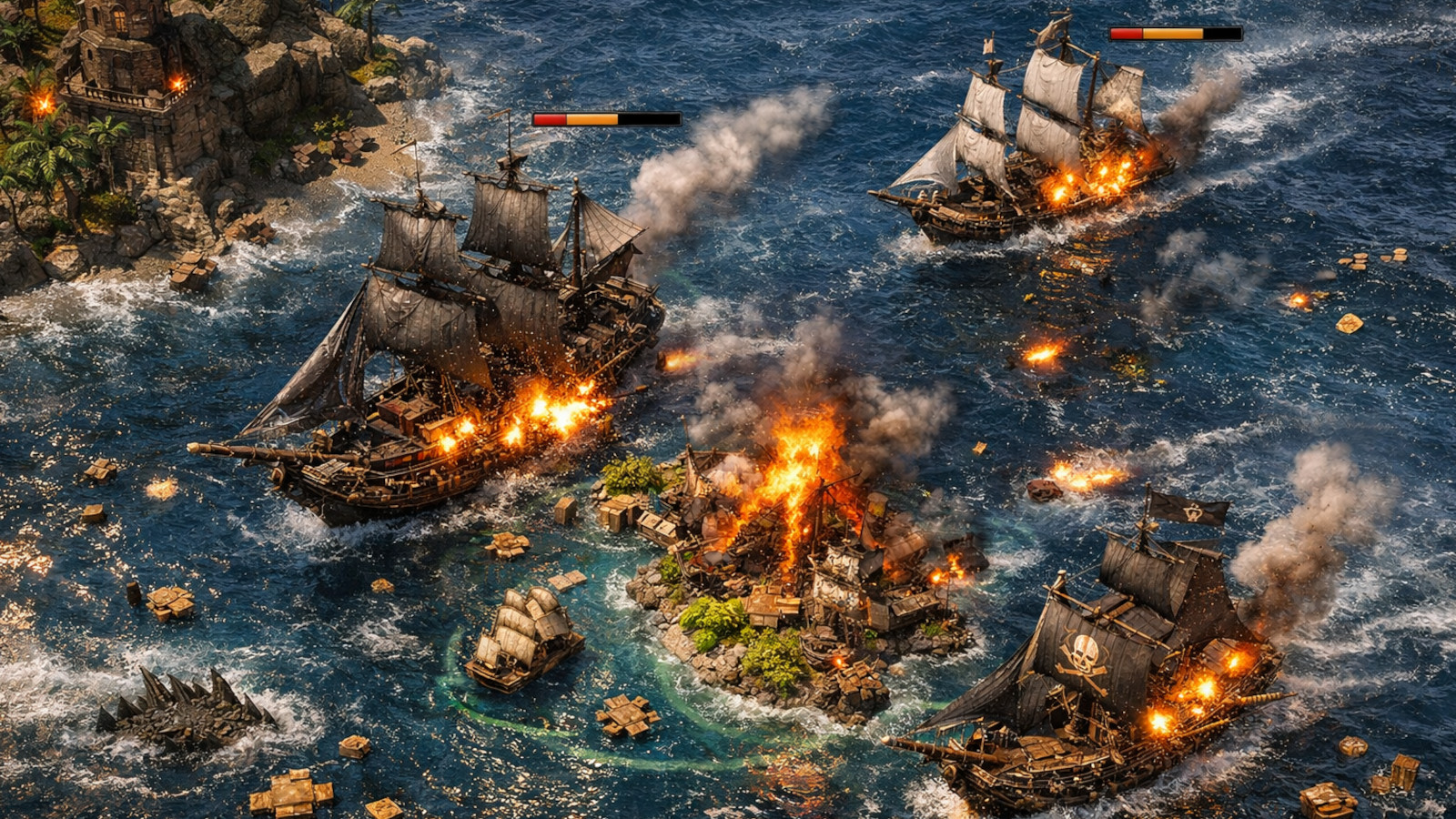
When you design a multiplayer naval game, the shape of the map decides how players behave long before any rulebook does. Put everyone into one giant, flat ocean with uniform spawns and two things go wrong immediately: new captains get run over five minutes outside the dock, and veteran captains spend half their evening sailing across empty water looking for something worth fighting.
In SeaGods, our world is built around a deliberate geography: a connected grid of nine distinct seas, anchored by a central island port. Today we are looking at how that nine-sea structure works, why crossing a sea border is a meaningful choice, and how the first three seas will play when the alpha server opens.
Why a grid of nine seas beats a single endless ocean
Think of the nine seas in SeaGods as concentric rings of opportunity and danger, connected by navigable sea borders rather than level-select menus.
- The Inner Seas (Seas 1 to 3): The opening waters that form the spine of Phase 1 of our alpha test. Here, new captains learn top-down steering, broadside timing, harpoon hunting, shield management, and out-of-combat repairs while progressing through the early ship hulls and the opening mission chain.
- The Mid-Tier Waters (Seas 4 to 6): Deeper hunting grounds with heavier creature populations, tougher hostile vessels, and higher-value drops that reward upgraded cannons, specialized ammunition, and small-group cooperation.
- The Outer Seas (Seas 7 to 9): High-risk, high-reward endgame waters built for heavily outfitted warships, coordinated hunting parties, and alliance territory contests.
Because each sea is a bounded region with known borders, the ocean never feels vague. When someone in chat says there is a fight brewing near the north border of Sea 3, every captain on the server knows exactly where that is and how long it takes to sail there.
No level scaling: where you sail is your difficulty setting
One modern RPG trend we explicitly rejected in both SeaWar Sandbox V1 and SeaGods is automatic enemy level scaling. When monsters secretly scale up or down to match your level, upgrading your ship feels pointless because every fight takes the exact same number of broadsides.
In SeaGods, creatures and hostile ships belong to their sea. When you upgrade your hull, mount heavier cannons, and stock higher-tier cannonballs or harpoons, going back into Sea 1 feels noticeably faster and safer because you actually grew stronger. Conversely, pushing across the border into a higher sea before your hull is ready feels immediately dangerous, and surviving a sortie in deeper water pays out rewards that match the risk.
Crossing a border is a real navigation transition
We do not want SeaGods to feel like a lobby game where you click "Stage 4" from a dropdown menu. To reach another sea, you physically sail your ship to the border and cross over. That simple requirement creates natural maritime gameplay:
- Chokepoints and trade routes: Passages between seas become natural meeting points where merchants, monster hunters, and rival alliances cross paths.
- Tactical retreats: If a fight turns against you near a border, making a break for safer waters with your shields angled and repairs ready is a skill in itself.
- Supply planning: Before you sail three seas away from the central island port, you check your cannonballs, harpoons, and hull condition, because the voyage out and back is real distance.
Why Phase 1 of the alpha opens with the first three seas
As we explained in our alpha server announcement, all nine seas exist in the build, but Phase 1 of public testing will open only the first three seas.
Why? Because player density is the lifeblood of a multiplayer sea. Putting our first alpha wave into three connected seas guarantees that you will regularly see other sails on the horizon, test group combat against creatures, and stress-test server-authoritative movement and broadsides in populated waters. Once the opening progression curve and economy numbers are rock solid, we unlock the next ring of seas one step at a time.
How to prepare for the alpha
Everything you need to play SeaGods is already on your machine: a modern desktop web browser. There is nothing to download, no founder pack to buy, and no NDA when testing begins.
- Visit the new official SeaGods page for the full system overview and alpha roadmap.
- Subscribe to our RSS feed or bookmark the News page for the exact server opening date.
- Join the Phalangix Discord from the footer below to get alpha access instructions the moment the first three seas go live.
The water is ready. We will see you out there soon.