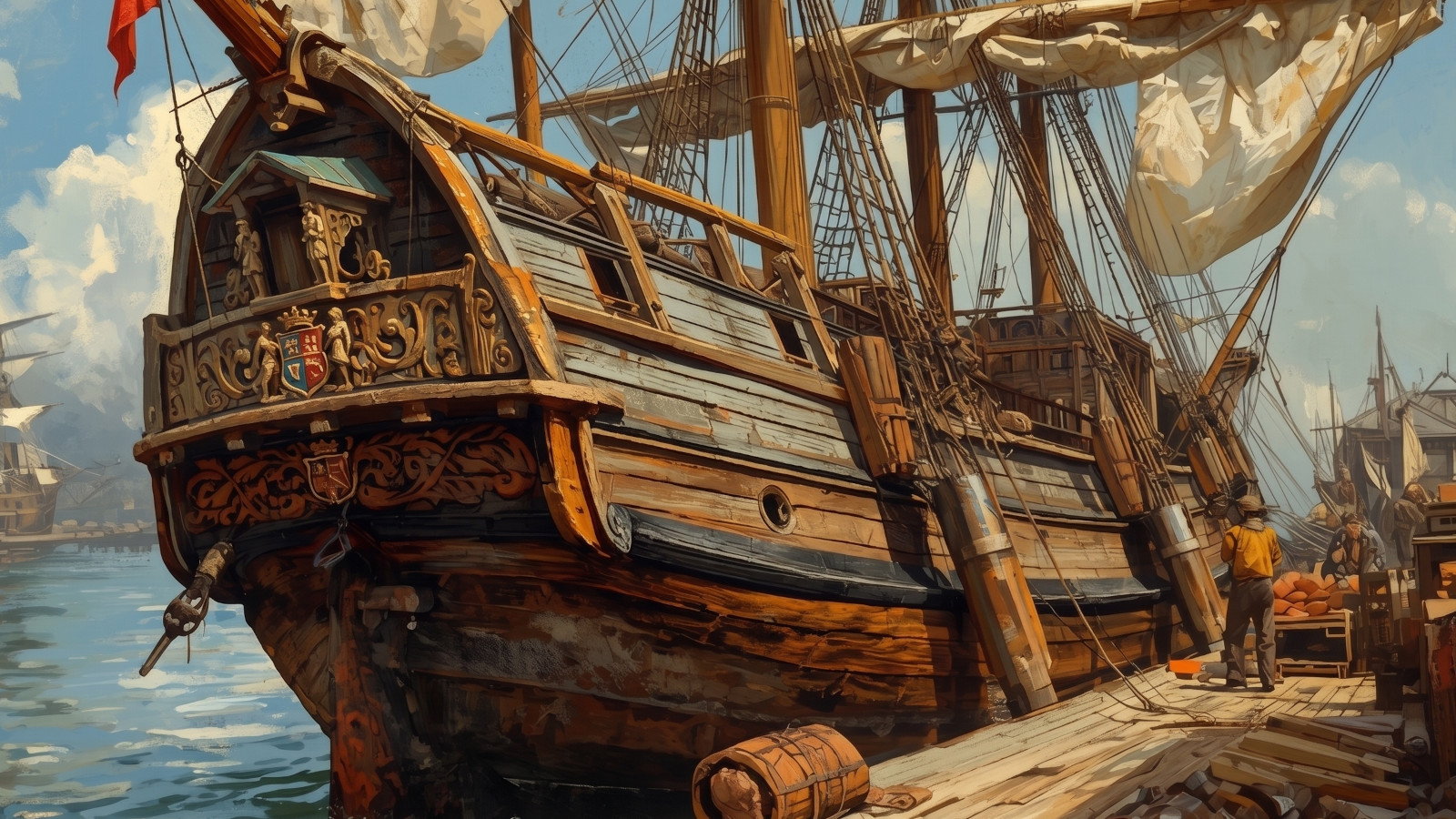
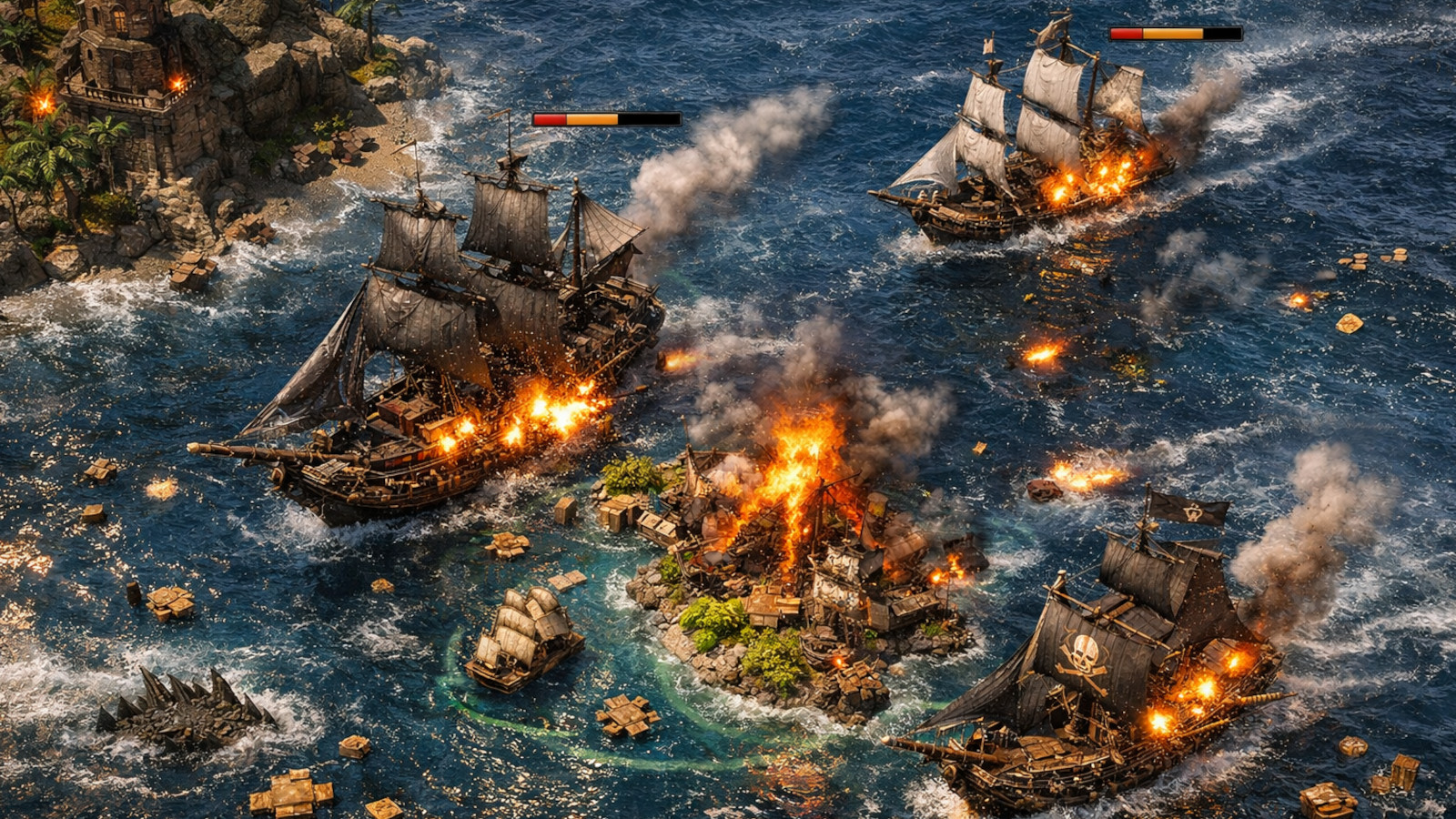
One of the easiest mistakes to make when building a naval game is spending 100 percent of your time on the water and treating the harbor as a flat shop menu that pops up when you press a hotkey. Plenty of games do it. You float in the middle of nowhere, click an icon in the corner of your screen, buy forty cannons from an invisible merchant, and keep sailing.
It is convenient, and it completely flattens the pacing of the game.
Think about why maritime stories work in the first place. A voyage only feels dangerous if there is a safe harbor you are trying to make it back to. Without a physical port on the map, the sea has no center of gravity. Every coordinate feels the same, and your ship never feels like it actually went anywhere and returned.
What Pirate Island taught us in SeaWar Sandbox V1
In SeaWar Sandbox V1, our entire 500-by-500 open sea revolves around a single anchor point in the south-east corner: Pirate Island.
When you wake up on The Door at the start of the campaign, Pirate Island is where Edd teaches you the ropes, where John the Pirate hands you your twelve campaign missions and three daily jobs, where Bronn sells cannons and gunpowder at the armory, where Lilly hires Cooks and Engineers in the tavern, and where Navis upgrades your hull all the way up to the Galleon.
More importantly, enemy spawn density thins out near the docks. When you limp back from the north-west with ten percent hull left after an early brush with a boss, seeing the docks of Pirate Island slide onto your minimap creates an immediate physical sense of relief. A menu hotkey can never give you that feeling.
Designing the central island port in SeaGods
When we moved from single-player to a nine-sea multiplayer world in SeaGods, the role of the port grew even larger. In a shared ocean, a central island harbor does four critical jobs at once:
1. It separates combat time from preparation time
Good RPG pacing alternates between high-focus action (steering, dodging, firing broadsides, watching the minimap) and low-stress planning (comparing cannon loadouts, restocking hollow or explosive ammunition, reviewing contracts, and checking market prices). Dropping anchor at the port gives captains a dedicated breathing room between sorties.
2. It gives the economy a physical home
In SeaGods, the central island houses working services: an armorer dealing in weapons and stock, trade and market interfaces, and contract and mission boards. Knowing that you sail out from the island to earn resources and sail back to outfit your fleet makes the nine-sea grid feel like a real maritime geography.
3. It turns surviving the return trip into part of the loop
When port services live at a real place on the map rather than on a floating hotkey, sailing out into the outer seas carries natural tension. You do not just need enough ammunition and hull points to win a fight in Sea 6; you need enough to make the passage back to harbor.
4. It creates a social gathering point
In a multiplayer browser MMO, seeing other captains anchored around the same harbor, forming groups before heading into deeper seas, or gearing up for an alliance operation makes the world feel alive before a single cannon is fired.
How we roll port systems out across the alpha
As we outlined in our alpha server preview, we are taking a disciplined approach to testing: Phase 1 of the SeaGods alpha focuses tightly on the first three seas, core top-down combat, early hull progression, and the opening mission chain so we can measure combat and pacing cleanly. The deeper port services, market tabs, and alliance territory systems unlock step by step in subsequent phases as each layer proves itself under live player load.
If you want to explore Pirate Island and meet John, Bronn, Lilly, Navis, and Edd right now, read the SeaWar Guide or grab the free offline build on our download page. And if you want to be among the first captains anchoring in SeaGods, join us on Discord.