Look at an old sixteenth-century nautical chart such as the Carta Marina and the first thing you notice is not the coastline. It is the water. Every blank stretch of ocean is packed with coiled serpents, tusked whales, and tentacled horrors capsizing caravels. Mapmakers did not draw monsters just to fill empty parchment. They drew them because an open ocean without landmarks feels psychologically infinite unless you give the danger a face.
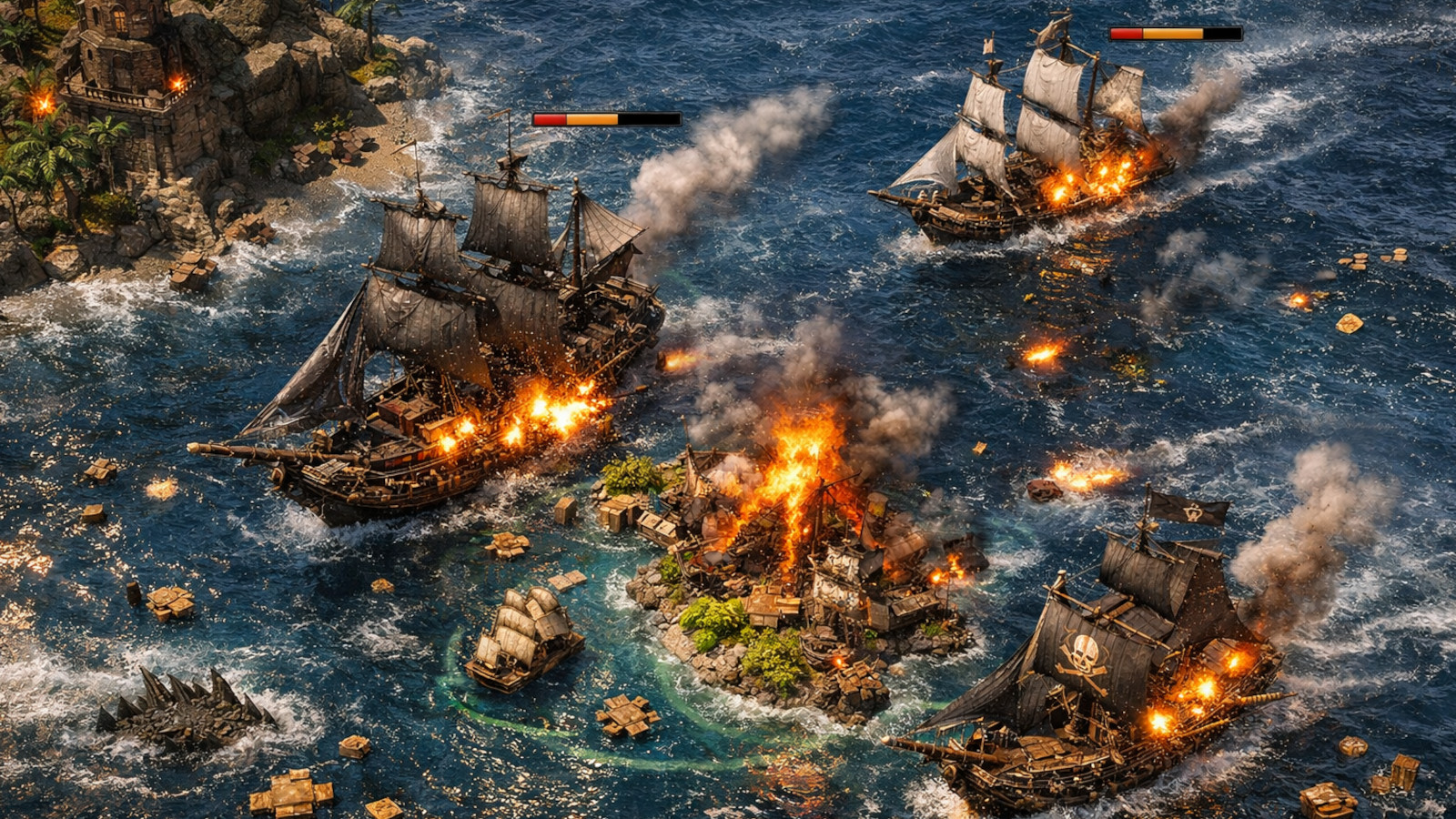
Naval games face the exact same design problem five hundred years later. Water is flat. If you sail across a massive map and only ever fight slightly larger copies of your own wooden ship, the horizon eventually blurs together. Put a Leviathan in the deep water, however, and suddenly every coordinate on the minimap means something.
1. The Kraken: from Norwegian folklore to the ultimate DPS check
The historical Kraken did not start out as a squid. In the thirteenth-century Norse saga Orvar-Oddr and Bishop Erik Pontoppidan's 1752 Natural History of Norway, the Kraken (or Hafgufa) was described as a creature the size of a floating island. Sailors would mistake its back for new land, drop anchor, and drown when the island sank beneath the waves. Only later, as giant squid carcasses washed ashore in the eighteenth and nineteenth centuries, did the Kraken take on the iconic tentacled silhouette we know today.
In naval game design, the Kraken works because it breaks the normal rules of broadside geometry. When you fight another ship, you know its turn radius and its firing arc. A Kraken attacks from below, punishes captains who stop moving, and forces you to balance hull repairs against sustained cannon fire. In SeaWar Sandbox V1, the Kraken sits at 200,000 HP and 2,500 damage per hit, acting as the gatekeeper between mid-game frigate captains and true endgame galleon commanders.
2. Moby Dick: the monster that fights back with momentum
Herman Melville published Moby-Dick in 1851, drawing on two very real nineteenth-century maritime nightmares: the 1820 sinking of the whaler Essex by an eighty-five-foot sperm whale in the South Pacific, and stories of Mocha Dick, a scarred albino bull whale off the coast of Chile that survived dozens of harpoon attacks before stove-in hulls became his calling card.
What makes a great whale boss different from a tentacled beast is speed and pursuit. A whale is a living battering ram. In SeaWar, Moby Dick carries 450,000 HP and hits for 5,000 damage, turning the open sea into a kiting test where range management and sail upgrades (+10% speed) matter just as much as cannon caliber.
3. Cthulhu and the cosmic deep
When H.P. Lovecraft wrote The Call of Cthulhu in 1926, he ended the story not with an incantation, but with a Norwegian steam-yacht ramming a rising horror in the South Pacific at full throttle. Maritime fiction and cosmic dread have been tied together ever since, because the ocean floor is the only place on Earth that still feels genuinely alien.
In a naval RPG progression ladder, cosmic bosses serve a clear purpose: they mark the transition from historical piracy to mythic endgame. When a captain first spots Cthulhu (100,000 HP) prowling the outer waters of SeaWar, the message is immediate and non-verbal: turn around, upgrade your hull at Pirate Island, and come back with Explosive ammunition.
4. Why monsters matter even more in a multiplayer sea
In a single-player sandbox like SeaWar Sandbox V1, bosses are personal milestones on your road to the Demon Lord's island. In a shared multiplayer ocean like SeaGods, sea monsters take on an even bigger role: they create flashpoints where players meet.
- Shared hunting grounds: When a high-value leviathan spawns in an outer sea, captains have to decide whether to cooperate for the kill or contest the waters around the drop.
- Weapon specialization: SeaGods features both cannons and harpoons as distinct combat systems, giving creature hunting its own tactical rhythm alongside ship-to-ship broadsides.
- Map identity across nine seas: Each of the nine seas in SeaGods has its own creature population and difficulty curve, ensuring that sailing from Sea 1 into deeper waters feels palpably different.
If you missed our earlier mythology feature, check out Charybdis: the myth behind the boss and our look at the Antikythera mechanism. Every monster we put in the water starts with a real maritime story.